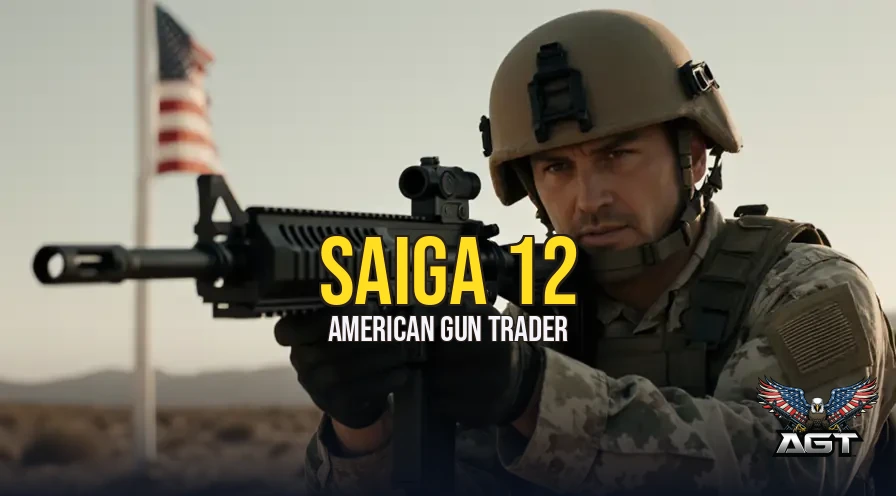
What is a Saiga 12 Shotgun?
The Saiga 12 is a semi-automatic, 12-gauge shotgun manufactured by the Russian Izhmash factory, based on the Kalashnikov AK-47 action. Imported in a 'sporter' configuration to comply with U.S. law, it became immensely popular for its reliability and its potential for conversion into a tactical, magazine-fed shotgun.
The Kalashnikov Shotgun's American Journey
The Saiga 12 shotgun landed on American shores as something of an anomaly. Built in the same factory that produced the legendary AK-47, it shared the same long-stroke gas piston system renowned for its brute-force reliability. However, to get past the stringent U.S. import regulations of the 1990s, particularly Section 922(r), the Saiga had to be dressed down. It arrived in a 'sporting' configuration that was a far cry from its military-grade roots.
This meant a traditional rifle-style stock instead of a pistol grip and a separate stock. The trigger group was moved rearward, connected by a long linkage bar to the original trigger position, which resulted in a notoriously poor trigger pull. It lacked features deemed 'non-sporting,' such as a threaded barrel for chokes or muzzle devices, a bayonet lug, or a high-capacity magazine. The shotguns were shipped with 5-round magazines, reinforcing their intended image as a simple hunting firearm. This sporterized version was a compromise, but it was the only way for the Izhmash (later Kalashnikov Concern) factory to tap into the massive American civilian market.
Despite these limitations, savvy American shooters saw the potential lurking beneath the surface. They recognized the robust AK action and understood that with some work, this neutered sporter could be transformed into the tactical shotgun it was always meant to be. This realization kicked off a cottage industry dedicated to reverse-engineering the import restrictions, giving rise to one of the most customizable shotgun platforms ever seen.
Anatomy of a Stock Saiga 12
Unboxing a factory-configuration Saiga 12 can be underwhelming if you're expecting a tactical powerhouse. The shotgun feels solid, a testament to its Russian manufacturing, but the ergonomics are awkward. The straight stock forces a lower grip, and the trigger, as mentioned, is often described as mushy and long. The handguard is a simple polymer piece, functional but basic. Sights are typically a simple bead or sometimes rudimentary rifle-style sights on the gas block.
The magazine release is a standard AK-style paddle, but inserting the proprietary 'rock-and-lock' magazines requires a specific technique that isn't as fast as the straight-insert magazines common on AR-platform firearms. The bolt hold-open is another unique feature. On most models, it's a small manual button or lever near the trigger guard that can be pressed to lock the bolt to the rear, but it does not automatically lock back on an empty magazine. This was a departure from the AK rifle, which has no bolt hold-open at all.
The most critical component, however, is the gas system. Most Saiga 12s feature a two-position adjustable gas regulator. This allows the user to vent more or less gas to cycle the action, accommodating the vast pressure differences between light birdshot loads and heavy buckshot or slugs. Understanding this system is fundamental to the Saiga 12 experience, as an incorrectly set gas system is the source of most cycling issues. For those looking to transform their firearm, understanding the intricate Saiga 12 conversion process is the first step toward unlocking its full potential.
| Feature | Saiga 12 (Factory Sporter) | Saiga 12 (Common Tactical Conversion) | Molot VEPR-12 |
|---|---|---|---|
| Caliber | 12 Gauge, 3" Chamber | 12 Gauge, 3" Chamber | 12 Gauge, 3" Chamber |
| Action | AK-Pattern, Long-Stroke Gas Piston | AK-Pattern, Long-Stroke Gas Piston | RPK-Pattern, Long-Stroke Gas Piston |
| Receiver | 1mm Stamped Steel | 1mm Stamped Steel | 1.5mm Stamped Steel (Thicker) |
| Stock | Fixed Sporter Stock | AK-Style Fixed, Folding, or AR Buffer Tube | Factory Folding Tubular Stock |
| Pistol Grip | None (Integrated into Sporter Stock) | Yes (AK or AR Style) | Yes (Factory AK Style) |
| Magazine System | Proprietary Rock-and-Lock | Rock-and-Lock or Aftermarket Magwell | Factory Magwell, Straight-Insert |
| Bolt Hold-Open | Manual Lever | Manual Lever | Automatic Last-Round Bolt Hold-Open |
| Sights | Bead or Basic Rifle Sights | Varies (AK Sights, Optics Rail) | RPK-Style Adjustable Sights |
| Factory Configuration | Compliant for Import | Non-Compliant (922r Parts Required) | Tactical (Factory Magwell/Folding Stock) |
The Conversion Ecosystem: Building a Tactical Beast
The true magic of the Saiga 12 lies in its modularity and the massive aftermarket that sprung up around it. A 'conversion' refers to the process of modifying the shotgun to restore its original AK ergonomics and tactical capabilities. The most basic conversion involves moving the trigger group forward to its original position. This requires cutting the old trigger guard off, drilling a few new holes in the receiver, and installing a new pistol grip, trigger guard, and a fire control group like the popular Tapco G2.
This single change dramatically improves the trigger pull and handling of the shotgun. From there, the options are nearly limitless. Owners can add AR-15 style buffer tubes to use collapsible stocks, or install side-folding stocks true to the AK platform's heritage. The simple polymer handguard can be replaced with railed systems from manufacturers like Krebs Custom or Carolina Shooters Supply, allowing for the attachment of vertical grips, lights, and lasers. Many owners also opt to have the barrel threaded to accept standard shotgun chokes or aggressive muzzle brakes to tame the 12-gauge recoil.
One of the most significant upgrades is the addition of a magazine well. Companies like JT Engineering and RAM developed magwells that could be riveted or bolted to the receiver, allowing for the use of straight-insert magazines instead of the slower rock-and-lock style. This modification makes reloads significantly faster, a critical advantage in competition or defensive scenarios. Properly executing these modifications can substantially increase the firearm's utility and market price, making it important for owners to have a grasp of understanding the true gun value before buying or selling a converted model.
Magazines, Ammo, and Reliability Tuning
A Saiga 12 is only as reliable as the magazine and ammunition you feed it. Factory Izhmash magazines are the gold standard for reliability but are often limited to 5 or 8 rounds and have become expensive and hard to find. The aftermarket stepped in with a wide array of options. SGM Tactical and AGP Arms produced popular polymer box magazines in 10- and 12-round capacities, and even 20- and 25-round drums became available from companies like ProMag.
However, not all magazines are created equal. Some aftermarket mags require fitting to the individual gun, and reliability can vary. The drum magazines, while impressive, add significant weight and can sometimes be finicky. The key is to find a brand that works reliably with your specific shotgun and stick with it.
Ammunition sensitivity is the Saiga's most discussed quirk. Because it's a gas-operated system designed with powerful Russian military loads in mind, it often struggles to cycle cheap, low-brass birdshot from American brands. These shells often don't produce enough gas pressure to reliably work the heavy bolt. The solution lies in tuning. First, ensure the gas regulator is on the correct setting for lighter loads. If problems persist, many owners perform modifications like polishing the bolt carrier and rails or opening up the gas ports to improve cycling with weak ammo. For many, simply sticking to full-power buckshot and slugs, which tend to run flawlessly, is the easiest path. This reliability with heavy loads is what makes it a formidable defensive tool, far removed from other other Kalashnikov-pattern firearms like the Draco pistol.
The Import Ban and Its Lasting Legacy
In 2014, executive actions targeting Russian industries in response to events in Ukraine specifically named Kalashnikov Concern. This immediately halted the importation of all their firearms, including the Saiga 12. The once-plentiful supply of these shotguns dried up overnight. Prices, which had been in the $500-$700 range for a stock model, began to climb steadily. Today, an unconverted Saiga 12 is a collector's item, and professionally converted models can command prices well over $1,500.
The ban created a vacuum in the market for a reliable, magazine-fed, AK-style shotgun. This void was quickly filled by other companies. Kalashnikov USA, a separate American company, began producing the KS-12, a shotgun based directly on the Saiga 12 design. The Chinese-made SDS Lynx 12 is another near-clone that accepts most Saiga 12 parts and accessories. While these alternatives exist, the original Russian-made Saiga 12 retains a certain prestige due to its authentic origins and proven durability.
For those looking to acquire one, the secondary market is the only option. It's essential for prospective buyers to understand what they are looking at—is it a stock sporter, a home-built conversion of questionable quality, or a professional build from a reputable shop? If you are considering a purchase, it's wise to research the legal process of how to buy a gun in your area and carefully inspect the firearm. You can often browse current listings for shotguns to get a feel for the current market prices and availability.
Is the Saiga 12 Still a Top Contender?
In a world now populated with AR-style shotguns like the Rock Island Armory VR80 and domestic AK clones, does the Russian original still hold up? The answer is a resounding yes. While AR-style shotguns may offer more familiar ergonomics to many American shooters, the Saiga's long-stroke piston action is inherently more reliable in adverse conditions and less sensitive to fouling than the direct impingement systems sometimes adapted for shotguns. It's a simpler, more robust design.
The Saiga 12's primary advantages remain its battle-proven action and the vast, mature aftermarket that still supports it. Parts, accessories, and expertise are widely available. While a modern clone like the KUSA KS-12 might be a more practical choice for a new buyer, the original Saiga 12 offers a piece of history with performance that still rivals or exceeds its contemporaries. Its design philosophy is a world away from highly modular but complex platforms like modern carbines like the SIG Sauer MPX, focusing instead on unstoppable function.
For the collector, the pre-ban Russian original is irreplaceable. For the competitive shooter or defensive-minded individual, a well-tuned Saiga 12 is still a formidable and incredibly reliable tool. It may no longer be the only game in town for tactical shotguns, but its influence is undeniable, and its performance continues to set a high bar.

Comments
No comments yet. Be the first to share your thoughts!
Login to CommentJoin the discussion and connect with other members