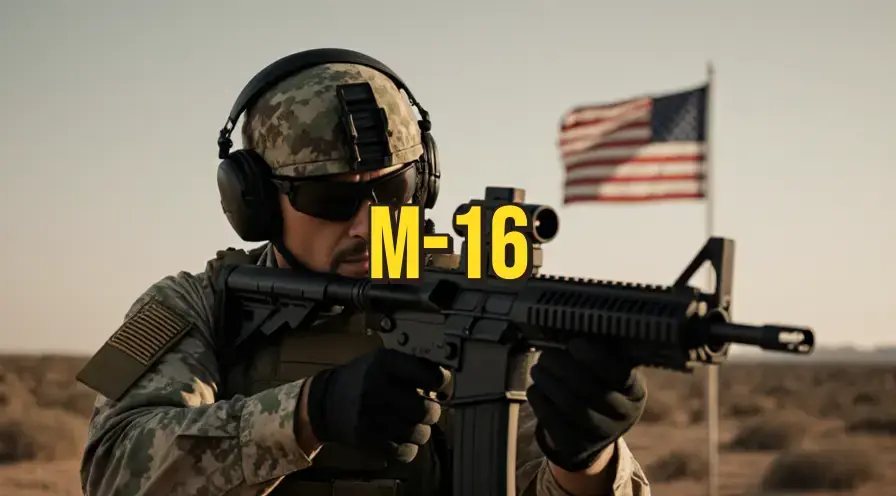
The M16 is the military 5.56 mm rifle adopted by the U.S. military in 1964. Civilian listings here are semi-auto AR-15s, not select-fire M16s.
The M16 rifle stands as a cornerstone of modern military small arms design, its lineage deeply intertwined with the evolution of American infantry weaponry. Developed from Eugene Stoner’s ArmaLite AR-15, the M16 was officially adopted by the U.S. military in 1964. Its impact on firearm development and tactical doctrine is undeniable, shaping military small arms for decades. This article provides a comprehensive technical and historical overview, focusing on its operational significance and its presence in the broader firearms market for informational purposes.
What is the M16 rifle and its primary function?
The M16 rifle is a lightweight, 5.56mm caliber, gas-operated, air-cooled, magazine-fed assault rifle. Originally designed for military combat, its primary function is to provide soldiers with a reliable, accurate, and controllable weapon for engaging targets at typical infantry ranges. It is characterized by its direct impingement gas system and modular design, which has allowed for numerous variants and upgrades throughout its service life.
Genesis and Adoption: From AR-15 to M16
The story of the M16 begins with Eugene Stoner’s innovative AR-15 design in the late 1950s. Stoner, working for ArmaLite, created a rifle that was significantly lighter and more accurate than the standard issue M14. The key innovation was the use of a smaller caliber, high-velocity projectile (the .223 Remington, later standardized as 5.56x45mm NATO) and a direct impingement gas system that cycled the bolt directly. The United States Air Force began acquiring AR-15s in 1962, and following extensive testing and modifications, the rifle was adopted by the U.S. Army as the M16 in 1964. Initial deployment in Vietnam highlighted both its strengths and weaknesses, leading to further refinements.
Technical Evolution and Key Variants
The M16 platform has undergone continuous improvement. Early models faced reliability issues, largely attributed to the ammunition used and a lack of proper cleaning procedures. These challenges led to the development of the M16A1, which incorporated a chrome-lined bore and chamber, a forward assist, and improved magazines, significantly enhancing its durability and operational readiness. The subsequent M16A2 introduced further enhancements, including a heavier barrel, adjustable sights, and a redesigned stock, along with a change to controlled burst fire instead of full automatic to conserve ammunition and improve accuracy. The M16A3 and M16A4 represent further iterations, with the A4 model featuring a Picatinny rail system for mounting optics and accessories, reflecting the increasing demand for modularity in modern warfare.
The M16A1: The Workhorse of Vietnam
The M16A1 is perhaps the most iconic variant, serving as the primary infantry rifle for American forces during much of the Vietnam War. It retained the full-automatic fire capability of the original M16 but addressed critical reliability concerns. The addition of the forward assist allowed the user to manually ensure the bolt was fully chambered if it failed to close on its own, a feature often debated but deemed necessary by many operational units. Its lightweight and manageable recoil made it a capable weapon for infantry engagements.
The M16A2: Refinement and Standardization
The M16A2 marked a significant step in the rifle’s evolution. It was designed to address lessons learned from the M16A1’s performance and to standardize certain features across NATO. The transition to a 3-round burst fire mechanism, replacing full-automatic fire, was a key change aimed at improving battlefield effectiveness and ammunition discipline. The M16A2 also featured a heavier barrel profile for increased sustained fire capability and a removable carrying handle that revealed a Picatinny rail for optics, laying the groundwork for future modularity.
The M16A4: The Picatinny Rail Era
The M16A4 is the latest iteration of the M16 rifle to see widespread adoption by the U.S. military. Its most defining characteristic is the integration of the Picatinny rail system (MIL-STD-1913) across the upper receiver. This allows for the easy attachment and interchangeability of a wide array of optical sights, tactical lights, laser aiming devices, and other accessories, making it a highly adaptable platform for diverse combat environments and mission requirements. While the M4 carbine has largely supplanted it as the primary service rifle for many units, the M16A4 remains a significant part of the U.S. military inventory.
Technical Specifications Comparison
The M16 family of rifles, while sharing a common lineage, exhibits distinct technical differences across its various models. Understanding these specifications is crucial for appreciating their operational capabilities and historical context. The following table outlines key technical data for the M16A1, M16A2, and M16A4 variants.
| Specification | M16A1 | M16A2 | M16A4 |
|---|---|---|---|
| Caliber | 5.56x45mm NATO | 5.56x45mm NATO | 5.56x45mm NATO |
| Action | Gas-operated, direct impingement | Gas-operated, direct impingement | Gas-operated, direct impingement |
| Overall Length | 39.6 inches (1006 mm) | 39.6 inches (1006 mm) | 39.6 inches (1006 mm) |
| Barrel Length | 20 inches (508 mm) | 20 inches (508 mm) | 20 inches (508 mm) |
| Weight (unloaded) | 6.5 lbs (2.95 kg) | 6.85 lbs (3.1 kg) | 7.2 lbs (3.27 kg) |
| Rate of Fire (cyclic) | 700-900 rpm | 700-900 rpm (burst mode limited) | 700-900 rpm (burst mode limited) |
| Effective Range | 550 yards (500 m) | 600 yards (550 m) | 600 yards (550 m) |
| Magazine Capacity | 20 or 30 rounds | 30 rounds | 30 rounds |
| Sight System | Adjustable rear aperture, post front | Adjustable rear aperture, post front | Picatinny rail for optics, post front |
| Fire Modes | Safe, Semi-Auto, Full-Auto | Safe, Semi-Auto, 3-Round Burst | Safe, Semi-Auto, 3-Round Burst |
The M16 in the Civilian Market: Legalities and Availability
The M16 rifle, in its original select-fire military configuration, is a Title II firearm under the National Firearms Act (NFA) and is heavily regulated in the United States. Civilian ownership of registered M16s manufactured before May 19, 1986, is possible for individuals who comply with all federal, state, and local laws, including a rigorous background check, payment of a $200 tax stamp, and registration with the Bureau of Alcohol, Tobacco, Firearms and Explosives (ATF). These pre-’86 transferable M16s are rare and command extremely high prices in the collector’s market. Semi-automatic variants, often referred to as AR-15 style rifles, are widely available to civilians and share many design features with the M16 but lack the full-automatic or select-fire capability. These semi-automatic rifles are not subject to the same NFA restrictions as their select-fire counterparts.
Impact on Firearm Design and Innovation
The M16’s influence extends far beyond its direct military application. Its lightweight construction, modular design, and the adoption of the 5.56x45mm cartridge set new standards for infantry rifles. The direct impingement gas system, though sometimes controversial, proved to be a robust and effective method of operation, influencing countless subsequent firearm designs. The M16 platform’s inherent modularity paved the way for the development of the AR-15 as a highly customizable rifle for civilian shooters, sport shooters, and law enforcement agencies. The Picatinny rail system, popularized by the M16A4, has become a de facto standard for accessory mounting across a vast range of firearms. The M16’s success also contributed to the broader acceptance and proliferation of assault rifles with intermediate cartridges, fundamentally altering the landscape of modern military small arms.
Conclusion: A Lasting Legacy
The M16 rifle is more than just a firearm; it is a symbol of a significant era in military history and a testament to innovative firearm engineering. From its controversial beginnings to its evolution into a reliable and adaptable weapon system, the M16 has left an indelible mark on the world of firearms. Its technical specifications, operational history, and enduring influence on modern rifle design continue to make it a subject of significant interest for collectors, enthusiasts, and those interested in military technology.

Comments
No comments yet. Be the first to share your thoughts!
Login to CommentJoin the discussion and connect with other members