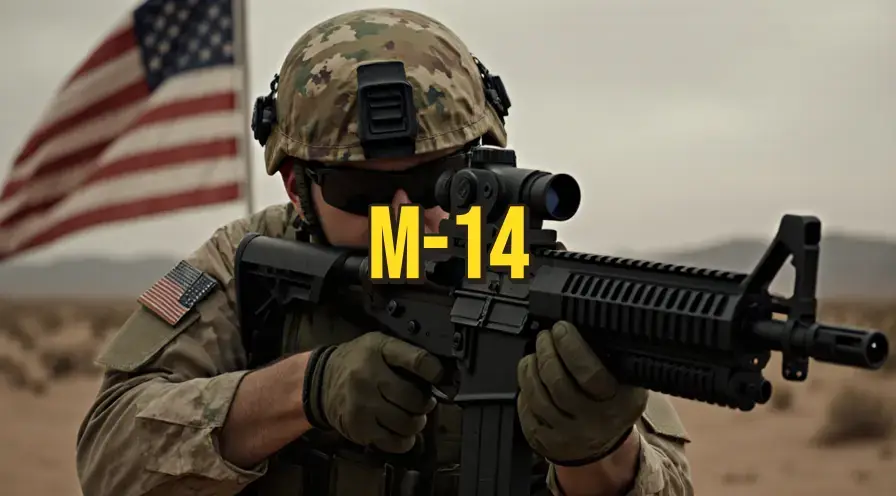
The M14 rifle is a select-fire rifle chambered in 7.62x51mm NATO. This page is the history and the listings for that rifle.
The M14 rifle stands as a significant, albeit brief, chapter in American military firearms history. Though its service as the standard-issue infantry rifle was relatively short-lived, its design and subsequent adaptations have ensured its enduring presence in the shooting community, particularly among collectors and sport shooters. This article provides an in-depth look at the M14, its technical intricacies, its evolution, and its current standing in the firearms market.
What is the M14 rifle and why is it still discussed?
The M14 rifle is a select-fire (capable of both semi-automatic and fully automatic fire) rifle chambered in 7.62x51mm NATO. It is discussed due to its historical significance as a post-World War II American service rifle, its robust design, and its continued use and modification for civilian and specialized military roles, making it a sought-after firearm.
Origins and Development: A Post-War Transition
The genesis of the M14 rifle can be traced to the post-World War II era, a period of intense military modernization. Following the widespread adoption of the M1 Garand, the U.S. Army and other branches recognized the need for a more versatile and potent infantry weapon. The desire was for a rifle that could bridge the gap between the semi-automatic M1 Garand and the heavier automatic rifle roles, while also chambered in a more powerful cartridge than the intermediate 7.62x39mm favored by Soviet forces. This led to the development of the 7.62x51mm NATO round, which became the standard for many Western allies.
The Springfield Armory T44 Program
Central to the M14's lineage is the T44 program, initiated by Springfield Armory. This program aimed to develop a new rifle based on lessons learned from the M1 Garand, but incorporating advancements and chambered in the new NATO round. Several prototypes were evaluated, with the T44E4 emerging as the frontrunner. It retained the Garand's operating system but featured a detachable box magazine and a shorter barrel profile compared to some earlier proposals. The T44E4 was eventually standardized as the M14.
Initial Adoption and the Quest for Versatility
The M14 was officially adopted by the U.S. Army in mid-, with subsequent adoption by the Marine Corps and other branches. It was intended to be a "one-rifle, one-weapon system," capable of fulfilling the roles of a battle rifle, a designated marksman rifle (DMR), and a light machine gun. Its select-fire capability and the power of the 7.62x51mm NATO round were seen as key to achieving this versatility. However, the rifle's full-automatic fire proved to be difficult to control accurately, especially in sustained bursts, and its weight and length were also factors in its operational effectiveness.
Technical Specifications and Design Features
The M14 rifle is a gas-operated, rotating bolt firearm. Its core operating mechanism is derived from the M1 Garand, utilizing a long-stroke gas piston system. This robust design contributes to its reliability in various conditions. The rifle feeds from a 20-round detachable box magazine, a significant upgrade from the 8-round en bloc clip of the M1 Garand. The M14 features a wooden stock, though later variants and civilian models have seen the introduction of synthetic materials. Its iron sights are adjustable, with a protected front post and a rear aperture sight, offering a good sight radius for accurate shooting.
Key Technical Specifications Table
| Feature | Specification |
|---|---|
| Caliber | 7.62x51mm NATO (.308 Winchester) |
| Action | Gas-operated, Rotating Bolt |
| Overall Length | 44 inches (1118 mm) |
| Barrel Length | 22 inches (559 mm) |
| Weight (Unloaded) | Approximately 8.7 lbs (3.95 kg) |
| Muzzle Velocity | Approximately 2,800 ft/s (853 m/s) |
| Effective Range | Up to 800 yards (732 m) |
| Magazine Capacity | 20 rounds |
| Sights | Adjustable aperture rear sight, protected front post |
Operating System: A Proven Yet Demanding Mechanism
The M14's gas system is a long-stroke piston, similar in principle to the M1 Garand. Gas is tapped from the barrel and drives a piston, which in turn operates the bolt carrier. This system is known for its durability and ability to function under harsh conditions. However, it also contributes to the rifle's weight and complexity compared to some later designs. The rotating bolt ensures a strong lock-up, essential for handling the powerful 7.62x51mm cartridge.
Ergonomics and Handling Characteristics
The M14, with its traditional wooden stock and full-length barrel, possesses a classic rifle profile. Its weight, while contributing to stability and recoil management, can be a factor in prolonged carrying. The select-fire switch is located on the right side of the receiver, and the safety is a lever type, located forward of the trigger guard. The rifle's balance and handling are generally considered good for its intended roles, though its length can make it less maneuverable in confined spaces.
Service Life and the Shift to the M16
The M14's tenure as the standard infantry rifle was notably brief. Despite its robust design and powerful cartridge, several factors contributed to its early replacement by the M16 rifle. The escalating conflict in Vietnam highlighted the need for a lighter, more manageable weapon chambered in an intermediate cartridge. The M16, firing the 5.56x45mm NATO round, offered significantly less recoil, making it easier for soldiers to control in full-automatic fire and allowing them to carry more ammunition. Furthermore, the M14's performance in jungle environments was hampered by its susceptibility to jamming when exposed to moisture and dirt, a problem exacerbated by its gas system and ammunition.
The M14's Combat Experience
While its time as the primary infantry rifle was limited, the M14 saw combat in Vietnam and other early engagements. Its accuracy and stopping power were appreciated by those who used it, particularly in engagements at longer ranges. However, the logistical challenges and the perceived shortcomings in close-quarters combat and sustained automatic fire led to the strategic decision to transition to the M16. This transition was not without controversy, as many soldiers and officers were reluctant to abandon the proven power of the 7.62mm round for the smaller 5.56mm round.
The M14's Enduring Roles
Despite being supplanted as the standard rifle, the M14 did not disappear from military service entirely. Its inherent accuracy and the power of its cartridge made it an excellent platform for designated marksman roles. Specialized variants, such as the M14 Enhanced Battle Rifle (EBR), were developed to fulfill these precision fire requirements. These modern iterations often feature improved stocks, optics, and barrel configurations, allowing the M14 to remain relevant in specialized military applications where longer-range engagements are expected.
Modern Adaptations and Civilian Ownership
The M14 rifle continues to hold a strong appeal in the civilian firearms market. Many M14 rifles, particularly those manufactured by Springfield Armory in the past, are highly sought after by collectors. Furthermore, civilian-legal semi-automatic versions of the M14, often referred to as M14/S or M1A rifles, are produced by various manufacturers, including Springfield Armory itself. These civilian variants retain the core design and aesthetic of the original M14 but are configured for semi-automatic fire only and comply with federal regulations regarding NFA items.
The Springfield Armory M1A Series
The M1A series, produced by Springfield Armory, represents the most prominent civilian adaptation of the M14. These rifles are built to closely resemble the original military rifle but are strictly semi-automatic. They are available in various configurations, including standard models, National Match versions (tuned for enhanced accuracy), and tactical variants with modern chassis systems. Based on current inventory trends and collector demand, M1A rifles are consistently popular among enthusiasts who appreciate the rifle's history, ergonomics, and shooting characteristics.
Post-Ban and Pre-Ban Considerations
For collectors and enthusiasts in certain jurisdictions, the distinction between "pre-ban" and "post-ban" M14-style rifles can be significant. Pre-ban rifles may have certain features that are restricted on post-ban models due to federal and state-level firearms regulations. Understanding these distinctions is crucial for legal ownership and for appreciating the historical context of different production runs. In our marketplace data, pre-ban M14 variants often command higher prices due to their rarity and compliance with older regulatory frameworks.
Accuracy and Performance in Civilian Use
In civilian hands, the M14 platform, particularly in its National Match and custom-built configurations, is renowned for its accuracy. The long sight radius, the inherent stability of the platform, and the power of the 7.62x51mm NATO round allow for precise shooting at extended distances. Many civilian shooters use M1A rifles for competitive shooting disciplines, recreational target practice, and as a potent hunting rifle for larger game where its power and range are advantageous. The rifle's recoil, while manageable for most shooters, is more pronounced than that of smaller caliber rifles.
The M14 Rifle in the Collector Market
The M14 rifle holds a special place in the hearts of firearms collectors. Original, issue-grade M14 rifles are rare and highly valuable, often fetching significant sums at auction. These pieces of history are appreciated not only for their mechanical qualities but also for their direct connection to a pivotal era in military history. The condition, provenance, and completeness of original M14 rifles are critical factors in their market value.
Factors Influencing Collector Value
Several factors contribute to the desirability and value of M14 rifles for collectors. Original military-issue rifles, especially those with documented service history or belonging to specific production runs, are highly prized. The presence of original markings, the condition of the finish, the stock (especially if it's a desirable wood type or shows unit markings), and the overall functionality of the firearm all play a role. Springfield Armory's pre-ban M1A rifles also hold considerable collector interest. Based on current inventory trends, rifles that are in excellent original condition, with matching numbers and desirable configurations, are the most sought-after.
Distinguishing Military vs. Civilian Models
It is essential for collectors and potential buyers to distinguish between genuine military-issue M14 rifles and civilian semi-automatic M1A variants. Military M14s are select-fire and are subject to strict federal regulations, making their private ownership exceptionally rare and highly controlled. Civilian M1A rifles are semi-automatic only and are legally available to qualified individuals. Differences can be subtle, often involving internal component markings, receiver cuts, and the presence or absence of full-automatic components. Expertise is often required to correctly identify and value these firearms.
Conclusion: An Enduring Legacy
The M14 rifle, though its reign as the standard U.S. military infantry rifle was short, has carved out a lasting legacy. Its robust design, powerful cartridge, and the iconic silhouette have cemented its place in firearms history. From its origins as a post-war solution to its continued relevance in specialized military roles and its enduring popularity among civilian shooters and collectors, the M14 remains a significant and fascinating firearm. Its technical sophistication and historical importance ensure that the M14 will continue to be a subject of interest and admiration for generations to come.


Comments
No comments yet. Be the first to share your thoughts!
Login to CommentJoin the discussion and connect with other members