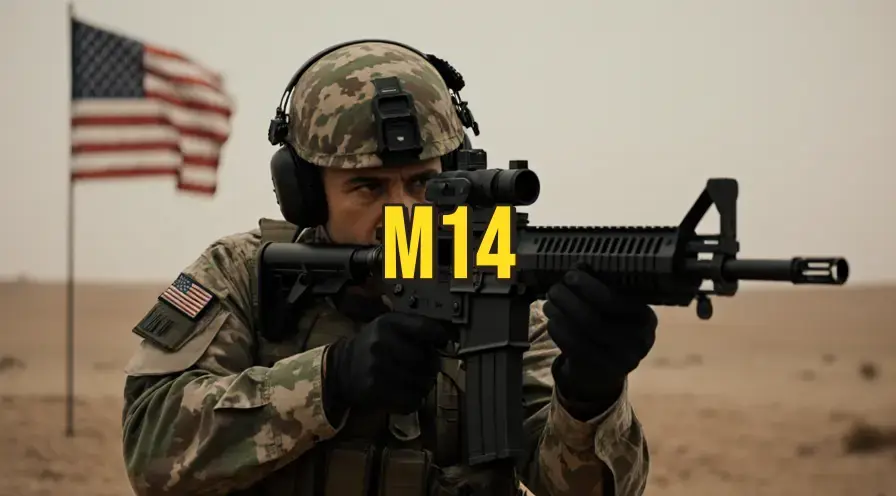
The M14 rifle, a pivotal firearm in American military history, represents a complex evolution of rifle design. Though its tenure as the standard-issue service rifle was relatively brief, its impact, technological advancements, and subsequent adaptations continue to resonate within firearms communities and specialized military applications. This article delves into the technical intricacies, notable variants, and the enduring legacy of the M14 platform.
What is the M14 rifle?
The M14 rifle is a select-fire, semi-automatic rifle chambered in 7.62x51mm NATO. It was developed from the M1 Garand and was the standard-issue U.S. infantry rifle from to the mid-1960s. Known for its power and accuracy, it has been adapted for designated marksman and sniper roles.
Historical Context and Development
The development of the M14 rifle was a direct response to perceived shortcomings of the M1 Garand and the need for a new standard infantry weapon following World War II and the Korean War. The U.S. military sought a rifle that offered greater range and accuracy than the M1 Garand, while also incorporating features like select-fire capability and lighter weight compared to some contemporary designs. The T44E4 and T44E5 prototypes, which eventually became the M14, were the culmination of extensive testing and refinement of existing designs. The rifle was officially adopted in the late 1950s, intended to replace the M1 Garand, the M1 carbine, and the BAR (Browning Automatic Rifle) with a single, versatile weapon system.
Adoption and Initial Service
The M14 entered service in 1957, with widespread issue beginning shortly thereafter. It was chambered in the powerful 7.62x51mm NATO cartridge, offering superior ballistics and range compared to the .30-06 Springfield of the M1 Garand. The rifle’s design incorporated elements from the M1 Garand, such as its rotating bolt and receiver shape, but also introduced a detachable box magazine and a selector switch for semi-automatic and fully automatic fire. Early models were designated as the M14, with subsequent refinements leading to the M14E2 (later M14A1) variant designed for automatic rifle roles.
Challenges in Service
Despite its intended advantages, the M14 faced significant challenges during its operational service. The rifle’s full-automatic fire was notoriously difficult to control, leading to excessive ammunition expenditure and limited practical utility in sustained automatic fire. Furthermore, the rifle’s weight and length, combined with its powerful cartridge, made it cumbersome for soldiers in the dense jungle environments encountered in Vietnam, where it first saw significant combat. The complexities of its manufacturing and the cost of production also became factors in its eventual replacement.
Technical Specifications and Design Features
The M14 rifle is a gas-operated, rotating bolt firearm. Its robust construction and the powerful 7.62x51mm NATO cartridge contribute to its accuracy and stopping power. The rifle features a distinctive wooden stock, though later variants explored fiberglass and composite materials. The iron sights are adjustable, and the receiver is designed to accept a scope mount for precision shooting applications.
Core Components and Operation
At its core, the M14 utilizes a gas piston system to cycle the action. When a round is fired, expanding gases are directed through a gas port in the barrel, pushing a piston rearward. This piston action unlocks the rotating bolt, extracts the spent casing, and loads a new round from the detachable magazine. The selector switch allows the shooter to choose between semi-automatic and fully automatic fire modes, though as noted, the latter proved difficult to manage effectively.
Ammunition and Ballistics
The M14’s chambering in 7.62x51mm NATO is a defining characteristic. This cartridge is known for its significant energy and effective range, making the M14 capable of engaging targets at distances exceeding those of many intermediate cartridges. The full-power nature of the 7.62x51mm NATO round contributes to the rifle’s recoil, particularly in full-automatic mode.
Notable Variants and Modern Adaptations
While the M14’s time as a standard infantry rifle was limited, its design proved adaptable. Several variants were developed, and the platform has been significantly re-engineered for specialized roles, most notably as designated marksman rifles (DMRs) and sniper rifles. These modern iterations often incorporate advanced materials, improved optics, and enhanced ergonomics.
M14E2/M14A1
The M14E2, later redesignated as the M14A1, was an attempt to convert the M14 into a squad automatic weapon. It featured a heavy barrel, a pistol grip, a folding bipod, and a different stock designed to mitigate recoil. While an improvement over the standard M14 in the automatic role, it was still outclassed by dedicated machine guns and saw limited widespread adoption.
M21 Sniper Weapon System
Perhaps the most successful adaptation of the M14 platform is the M21 Sniper Weapon System. Developed by the U.S. Army Marksmanship Unit, the M21 is a semi-automatic sniper rifle that utilizes select M14 receivers. These rifles are meticulously accurized, fitted with high-quality optics, and often feature upgraded stocks and barrels. The M21 proved highly effective in Afghanistan and Iraq, earning a reputation for reliability and accuracy in precision roles.
Modern DMRs and Civilian Variants
In recent years, civilian manufacturers have revived and modernized the M14 design. These modern interpretations, often referred to as M14-style rifles or sometimes inaccurately as M14s, incorporate contemporary materials like fiberglass or polymer stocks, Picatinny rails for accessory mounting, and often feature improved barrel profiles and trigger mechanisms. While retaining the core aesthetic and operating principles of the original M14, these rifles are built for civilian markets, offering a blend of historical design and modern firearm technology. Companies such as Springfield Armory (with its M1A series) produce popular civilian versions, though these are typically semi-automatic only.
Technical Specifications Table
Below is a comparison of key technical specifications for the original M14 service rifle and a representative modern civilian variant. Note that civilian variants are generally semi-automatic only and may have variations in materials and features.
| Feature | M14 (Service Rifle) | Springfield Armory M1A (Civilian Variant) |
|---|---|---|
| Caliber | 7.62x51mm NATO | 7.62x51mm NATO |
| Action | Gas-operated, rotating bolt | Gas-operated, rotating bolt |
| Length (Overall) | 44 inches (1118 mm) | Approx. 44 inches (1118 mm) (varies by barrel/stock) |
| Barrel Length | 22 inches (559 mm) | 22 inches (559 mm) (standard) |
| Weight (Unloaded) | Approx. 11 lbs (5 kg) | Approx. 9.5 - 10.5 lbs (4.3 - 4.8 kg) (varies by stock/material) |
| Magazine Capacity | 20 rounds | 10 or 20 rounds (legal restrictions may apply) |
| Rate of Fire | Semi-automatic, Fully automatic (approx. 650-750 rpm cyclic) | Semi-automatic only |
| Effective Range | Up to 800 yards (730 m) | Up to 800 yards (730 m) |
| Stock Material | Wood (walnut) | Wood, fiberglass, polymer (modern variants) |
The Enduring Legacy of the M14
The M14’s story is one of both triumph and compromise. While it struggled to meet the demands of modern warfare as a primary infantry rifle, its inherent accuracy and the power of its cartridge ensured its survival in specialized roles. The M21 sniper rifle is a testament to its potential for precision. Furthermore, the platform's robust design has inspired a generation of semi-automatic rifles that evoke its iconic silhouette and powerful performance.
Impact on Firearms Design
The M14's development process and its eventual limitations provided valuable lessons for future rifle designs. The quest for a lighter, more controllable rifle led directly to the adoption of the M16 and its intermediate cartridge. However, the M14’s influence can still be seen in the continued development of semi-automatic precision rifles and designated marksman platforms that prioritize range and accuracy, often chambered in powerful cartridges similar to the 7.62x51mm NATO.
Current Availability and Market Trends
In our marketplace data, the original M14 service rifle is exceedingly rare and typically found only in military surplus auctions or as highly sought-after collector’s items, often with significant provenance. Civilian variants, such as the Springfield Armory M1A and rifles from other manufacturers, are readily available. Based on current inventory trends, demand for these M1A-style rifles remains consistent among collectors and shooters who appreciate their historical significance, robust construction, and potent caliber. Prices for these civilian variants can range widely depending on the specific model, configuration, and included accessories, often starting in the low thousands of dollars and extending upwards for premium or historically significant reproductions.
The M14 platform, despite its short service life as a standard rifle, has carved out a unique and lasting niche in firearms history. Its powerful cartridge, accurate potential, and iconic design ensure its continued relevance and appeal to enthusiasts and professionals alike.

Comments
No comments yet. Be the first to share your thoughts!
Login to CommentJoin the discussion and connect with other members