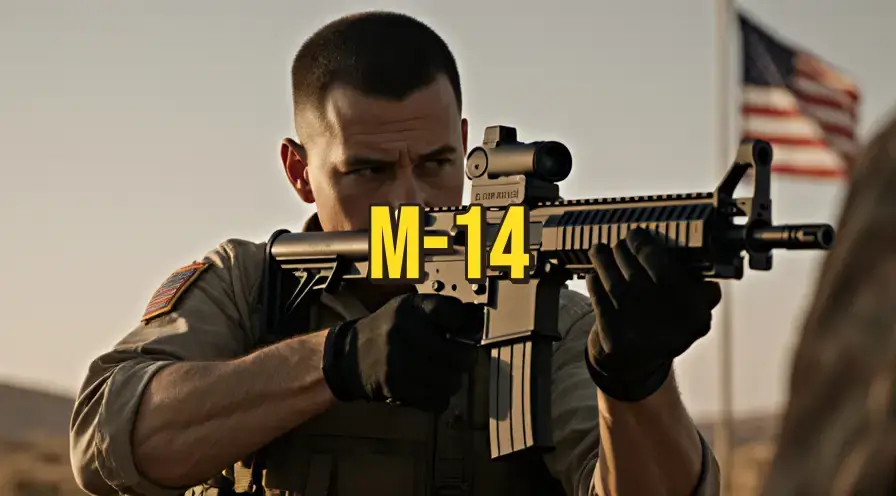
The M14 rifle, a linchpin in American military history, continues to resonate with firearms enthusiasts, collectors, and specialized military/law enforcement units. While largely supplanted by the M16/AR-15 platform for general infantry roles, its robust design, effective cartridge, and inherent accuracy ensure its continued relevance and desirability. This article delves into the technical intricacies, operational nuances, and market dynamics surrounding this iconic firearm.
Understanding the M14's Enduring Appeal
The M14 rifle is a select-fire, gas-operated battle rifle chambered in 7.62x51mm NATO, renowned for its accuracy and stopping power. Though phased out by the M16 in the mid-1960s for most frontline roles, it remains in service in limited capacities and is highly sought after by civilian collectors and shooters for its historical significance and powerful performance.
A Brief History and Design Philosophy
Born from the desire to consolidate the M1 Garand, M1 carbine, M3 submachine gun, and BAR into a single, standardized weapon, the M14 emerged as the winner of a competitive process in the mid-1950s. Springfield Armory's design, based on the M1 Garand, incorporated lessons learned from decades of combat experience. Its adoption as the standard issue rifle for the U.S. Army and Marine Corps in 1959 marked a significant transition, though its tenure was relatively short-lived due to its weight, length, and the advent of intermediate cartridge rifles like the AR-15.
The M14's design is a testament to robust engineering. It utilizes a rotating bolt, a long-stroke gas piston system, and a distinctive "Garand-style" top-loading during initial production runs, later transitioning to detachable box magazines. The rifle's construction emphasizes durability and reliability in harsh environments, a hallmark of its predecessor.
Technical Specifications and Variations
The standard M14 rifle, and its variants, possess specific technical characteristics that define its performance and handling. Understanding these specifications is crucial for anyone considering ownership, maintenance, or historical appreciation.
| Attribute | Specification |
|---|---|
| Caliber | 7.62x51mm NATO |
| Action | Gas-operated, rotating bolt |
| Overall Length | 44 inches (1118 mm) |
| Barrel Length | 22 inches (559 mm) |
| Weight (Unloaded) | 8.7 lbs (3.95 kg) |
| Rate of Fire (Cyclic) | ~700-750 rounds/minute |
| Effective Range | ~800 yards (730 meters) |
| Magazine Capacity | 20 rounds (detachable box) |
| Sights | Adjustable aperture rear sight, post front sight |
Over its service life and subsequent civilian and specialized military production, several key variants emerged. The most notable include:
M14 Variants and Modern Applications
M14 National Match (NM) Rifles
Developed for competitive shooting, M14 NM rifles were meticulously accurized. Modifications included hand-fitting of components, tighter tolerances, and specialized barrels, significantly enhancing accuracy over standard issue models. These rifles are highly prized by collectors and competitive shooters who value precision.
M14 EBR (Enhanced Battle Rifle)
The M14 EBR, and its subsequent iterations like the Mk 14 Mod 0, represent modernizations of the M14 platform. These rifles feature chassis systems, adjustable stocks, Picatinny rails for optics and accessories, and improved ergonomics. They have seen service with U.S. Navy SEALs and other special operations units, primarily as Designated Marksman Rifles (DMRs) and squad support weapons, leveraging the 7.62x51mm cartridge's extended reach and power.
M21 Sniper Weapon System (SWS)
Building upon the M14's accuracy, the M21 SWS was developed as a sniper rifle for U.S. Army Special Forces. It incorporated a glass bedded stock, a high-power scope (typically a Redfield 3-9x or ART II scope), and often a heavier barrel. The M21 proved to be a reliable and effective sniper platform for many years.
Civilian M14 Variants (Semi-Automatic)
Following the M14's discontinuation as a standard issue rifle, several manufacturers began producing semi-automatic civilian versions. These rifles, often referred to as M14-style rifles, retain the core design but are incapable of fully automatic fire. Companies like Springfield Armory, Inc. continue to produce these popular semi-automatic rifles, offering enthusiasts a taste of the M14's handling and performance. These are frequently sought after by collectors and sport shooters.
The 7.62x51mm NATO Cartridge
The chambering of the M14 in 7.62x51mm NATO is fundamental to its effectiveness. This full-power rifle cartridge offers significant advantages over intermediate cartridges like the 5.56x45mm NATO used in the M16. Its heavier projectile provides superior ballistic performance, especially at longer ranges, with better penetration through intermediate barriers and greater terminal energy. This makes the M14 and its derivatives particularly well-suited for designated marksman roles and situations requiring robust stopping power.
However, the cartridge also contributes to the rifle's recoil, weight, and ammunition capacity limitations compared to lighter platforms. Understanding the ballistics and handling characteristics of the 7.62x51mm NATO is essential for proficient operation of any M14-pattern rifle.
Market Trends and Collector Value
In our marketplace data, the M14 platform consistently attracts significant interest from a dedicated segment of the firearms community. Original, U.S. military-issue M14 rifles are exceedingly rare and command premium prices, often in the tens of thousands of dollars, due to their historical significance and strict legal restrictions on transfer. These are typically found only in specialized collections or museums.
More commonly available are the semi-automatic civilian variants and parts kits. Based on current inventory trends, well-maintained semi-automatic M14-style rifles from reputable manufacturers, such as Springfield Armory's M14 SOCOM or M1A series, typically range from $1,500 to over $3,000, depending on configuration, condition, and included accessories. National Match variants and rifles with historical provenance can fetch higher figures.
Parts kits, which consist of demilitarized components from original rifles, are also a significant part of the M14 market. These kits can be used by qualified individuals and licensed manufacturers to build semi-automatic rifles. Prices for these kits can vary widely, from under $1,000 for basic kits to several thousand dollars for complete, high-quality kits with desirable components.
Legality and Ownership Considerations
Ownership of M14-pattern rifles is subject to federal, state, and local laws. In the United States, civilian-owned M14s must be semi-automatic only to comply with the National Firearms Act (NFA) and other regulations. Fully automatic M14 rifles are considered machine guns and are subject to stringent registration and transfer requirements, making their legal acquisition by civilians extremely difficult and costly.
Individuals interested in acquiring an M14-style rifle should thoroughly research the laws in their specific jurisdiction. Furthermore, understanding the mechanics and maintenance requirements of these rifles is crucial for safe and responsible ownership. Many owners opt for specialized training to maximize their proficiency with these powerful firearms.
Maintenance and Durability
The M14's robust construction contributes to its reputation for durability. However, like any firearm, proper maintenance is essential to ensure longevity and reliable function. Regular cleaning, lubrication, and inspection of components, particularly the gas system, bolt, and operating rod, are critical. Given the rifle's age and the powerful cartridge it fires, owners should be vigilant for wear and tear, especially on original military surplus parts.
The availability of high-quality replacement parts, both original surplus and modern reproductions, is generally good for the civilian semi-automatic versions. This ensures that owners can maintain their rifles for many years to come. Specialized gunsmiths experienced with the M14 platform can be invaluable for complex repairs or upgrades.
Conclusion: An Enduring Icon
The M14 rifle stands as a significant artifact in firearms history. Its powerful cartridge, robust design, and evolution into specialized roles like the Designated Marksman Rifle have cemented its place in the modern firearms landscape. While it may no longer be the standard-issue infantry rifle, its legacy endures through its continued use in specialized military units, its popularity among competitive shooters, and its status as a highly coveted item for collectors and enthusiasts. For those who appreciate historical firearms, exceptional engineering, and potent performance, the M14 remains an unparalleled icon.

Comments
No comments yet. Be the first to share your thoughts!
Login to CommentJoin the discussion and connect with other members