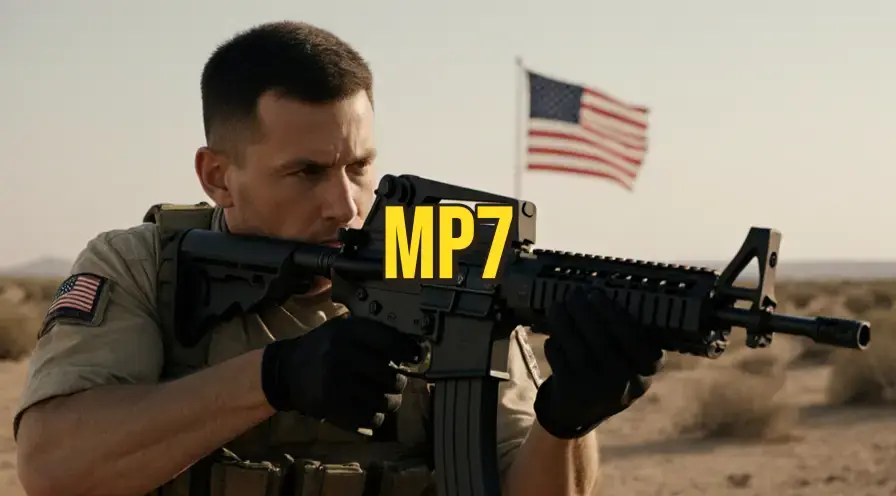
The Heckler & Koch MP7 personal defense weapon (PDW) stands as a significant development in compact, high-velocity firearm technology. Originally conceived to counter the threat of modern body armor, the MP7 fires a proprietary high-pressure pistol caliber round, the 4.6x30mm, offering superior penetration and terminal ballistics compared to traditional pistol cartridges. Its unique design emphasizes controllability, low recoil, and a high rate of fire within a remarkably small and lightweight package, making it a formidable weapon in close-quarters engagements.
What is the Heckler & Koch MP7?
The Heckler & Koch MP7 is a compact submachine gun (SMG) designed as a personal defense weapon (PDW). It is chambered in the proprietary 4.6x30mm cartridge, developed to defeat body armor. Its lightweight construction, ergonomic design, and selective-fire capability make it suitable for specialized military and police units requiring a concealable yet potent firearm for close-quarters combat and self-defense scenarios.
Design Philosophy and Evolution
The development of the MP7 stemmed from a NATO requirement for a new generation of personal defense weapons. The primary objective was to create a firearm that could be effectively operated by support personnel, vehicle crews, and special forces operators who needed a weapon more potent than a standard pistol but more compact and concealable than a rifle. This led to the development of the 4.6x30mm ammunition, engineered for high velocity and armor penetration, a distinct departure from conventional pistol calibers.
Early iterations of the MP7, such as the MP7A1, featured a slightly different stock design and improved ergonomics. The evolution continued with the introduction of the MP7A2, which refined the design further, offering enhanced modularity and user interface improvements. These updates reflect a continuous effort to adapt the platform to evolving operational requirements and user feedback.
Ammunition: The 4.6x30mm Cartridge
The heart of the MP7's effectiveness lies in its specialized ammunition. The 4.6x30mm round is a bottlenecked cartridge designed for high velocity and excellent penetration. Unlike traditional pistol rounds that rely on hydrostatic shock, the 4.6x30mm achieves its terminal effects through a combination of high velocity and a hardened projectile core. This allows it to defeat various types of soft body armor and helmets that would typically stop conventional handgun rounds.
The small diameter and high velocity of the 4.6x30mm round also contribute to reduced recoil, making the MP7 exceptionally controllable during full-automatic fire. This is crucial for maintaining accuracy and target engagement in rapid-fire situations. In our marketplace data, the availability and cost of 4.6x30mm ammunition are significant factors influencing the overall cost of ownership for MP7 enthusiasts.
Technical Specifications and Performance
The MP7's design prioritizes compactness and lightweight operation. It features a polymer receiver and a telescoping stock, allowing for a reduced profile when not in use. The weapon is ambidextrous, with controls easily accessible to both left and right-handed shooters. Its Picatinny rail system allows for the attachment of various optics, lights, and lasers, enhancing its tactical versatility.
Based on current inventory trends and enthusiast discussions, the MP7's rate of fire is a key performance metric. Typically exceeding 900 rounds per minute, this allows for a high volume of fire in a short period. However, the effectiveness of this rate of fire is intrinsically linked to the ammunition's performance and the weapon's controllability.
| Feature | MP7A1 | MP7A2 |
|---|---|---|
| Caliber | 4.6x30mm | 4.6x30mm |
| Action | Semi-automatic / Fully automatic | Semi-automatic / Fully automatic |
| Overall Length (Stock Extended) | Approx. 545 mm (21.5 in) | Approx. 545 mm (21.5 in) |
| Overall Length (Stock Retracted) | Approx. 340 mm (13.4 in) | Approx. 340 mm (13.4 in) |
| Barrel Length | Approx. 180 mm (7.1 in) | Approx. 180 mm (7.1 in) |
| Weight (Unloaded) | Approx. 1.2 kg (2.6 lbs) | Approx. 1.3 kg (2.9 lbs) |
| Magazine Capacity | 20 or 40 rounds | 20 or 40 rounds |
| Rate of Fire | Approx. 950 rpm | Approx. 950 rpm |
| Effective Range | Approx. 200 meters | Approx. 200 meters |
Legal Status and Civilian Availability
The legal status of the Heckler & Koch MP7 for civilian ownership in the United States is complex and highly dependent on specific federal, state, and local regulations. As a select-fire weapon, the MP7 is classified as a machine gun under the National Firearms Act (NFA). This classification imposes stringent requirements for civilian possession, including registration with the Bureau of Alcohol, Tobacco, Firearms and Explosives (ATF), a background check, and a significant tax stamp fee.
Due to these NFA regulations, fully automatic MP7s are exceptionally rare and prohibitively expensive for most civilian buyers. However, semi-automatic variants or 'pre-May' registered transferable machine guns do exist, though their availability is extremely limited. In our marketplace data, genuine transferable MP7s are seldom listed and command prices well into the tens of thousands of dollars. Furthermore, some states have outright bans on NFA-regulated items, making possession illegal regardless of federal compliance.
Semi-Automatic Variants and 'Pre-Sample' Models
For the civilian market, the most accessible (though still highly regulated) avenues for MP7 ownership typically involve semi-automatic conversions or the acquisition of 'pre-May' registered transferable machine guns. Semi-automatic versions are often manufactured as such, or can be converted from automatic counterparts, but they must comply with all NFA regulations regarding semi-automatic firearm conversions. These conversions typically involve modifying the fire control group to prevent fully automatic fire.
The term 'pre-May' refers to machine guns that were legally registered before the signing of the Firearm Owners' Protection Act (FOPA) in 1986. Any machine guns manufactured and registered after this date are generally not transferable to civilian ownership. Consequently, any transferable MP7 machine gun on the civilian market would almost certainly be a pre-May example, making its rarity and cost exceptionally high. Based on current inventory trends, finding such a firearm is a significant undertaking for collectors and enthusiasts.
Comparison with Other PDWs and SMGs
The MP7 occupies a unique niche when compared to other personal defense weapons and submachine guns. Its primary advantage lies in its specialized 4.6x30mm ammunition, which offers superior armor penetration compared to common pistol calibers like 9x19mm Parabellum found in many SMGs. This makes it a more effective choice against modern threats where body armor is prevalent.
In contrast, traditional SMGs chambered in 9mm, such as the Heckler & Koch MP5 or the Uzi, are more widely available and their ammunition is significantly less expensive. While these firearms excel in their respective roles, they generally lack the same level of armor penetration capability as the MP7. The MP7's compact size and light weight also give it an edge in concealability and maneuverability over some larger SMGs.
The Role of the MP7 in Modern Firearm Discussions
The MP7 frequently features in discussions among firearm enthusiasts, military historians, and tactical professionals. Its distinctive appearance, coupled with its advanced design and documented use by elite units, has cemented its status as a highly desirable, albeit restricted, firearm. The ongoing debate surrounding its effectiveness, particularly its armor-piercing capabilities, continues to fuel interest.
Based on current inventory trends and market analysis, the civilian demand for firearms with similar characteristics—compact size, high rate of fire, and advanced ammunition capabilities—remains strong. While direct civilian ownership of the MP7 is challenging due to regulatory hurdles, its influence can be seen in the development and interest in other compact firearms and specialized ammunition types.
Maintenance and Operational Considerations
Proper maintenance is crucial for ensuring the reliability and longevity of any firearm, and the MP7 is no exception. Due to its sophisticated design and the high pressures generated by its ammunition, adherence to manufacturer-recommended cleaning and lubrication schedules is paramount. Disassembly for routine cleaning typically involves removing the upper receiver from the lower receiver, followed by cleaning the bolt carrier group and barrel.
Operational considerations for the MP7 include its recoil management, which is generally excellent due to the cartridge's design and the firearm's inherent ergonomics. However, extended firing sessions, especially in fully automatic mode, can lead to increased heat buildup. Users must be mindful of this and allow the weapon to cool appropriately to prevent malfunctions or damage. Based on enthusiast feedback, the durability of the MP7's polymer components is generally high, but care should still be taken to avoid impacts or exposure to extreme environmental conditions.
Future Prospects and Civilian Alternatives
The future of the MP7, particularly in terms of wider civilian availability, remains uncertain due to its NFA classification. However, the principles behind its design—compactness, controllability, and effective ammunition—continue to influence firearm development. For enthusiasts seeking a similar feel or capability in a civilian-legal platform, several alternatives exist.
These alternatives often focus on compact pistol-caliber carbines (PCCs) chambered in popular calibers like 9mm, or even .22LR variants designed for training and plinking. While these may not replicate the specific armor-piercing capabilities of the 4.6x30mm round, they offer a more accessible entry point into the compact firearm market. In our marketplace data, the demand for high-quality, compact firearms that offer a balance of performance and legal compliance is a consistent trend.

Comments
No comments yet. Be the first to share your thoughts!
Login to CommentJoin the discussion and connect with other members